How Many Years Is 1000 Days?
How many years is 1000 days? It is about 2.7379 average years. Use the days to years calculator below for any amount, or reverse the direction to convert years to days.
Days to years calculator
How many years is 1000 days?
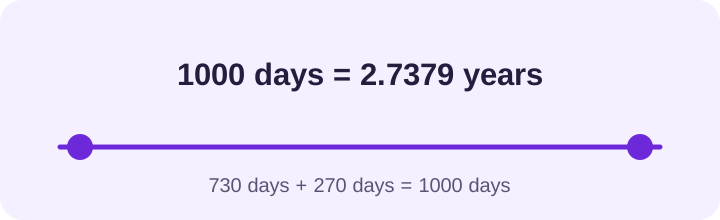
To convert 1000 days, divide 1000 by the average Gregorian calendar year of 365.2425 days. The result is 2.7379 average years. If you use a simple 365-day year instead, 1000 days is 2 full years plus 270 days. These are unit conversions, not a specific calendar interval from a chosen start date.
How many days is 2 years?
How many days is 2 years? It is 730 days when both years have 365 days, or 731 days when the two-year calendar interval includes one leap day. The average-year conversion used by this tool gives 730.485 days. For whole calendar days, a precise answer needs the start date; a period from one date to the same date two years later may span 730 or 731 days.
Why is a days-to-years result approximate?
The Gregorian calendar repeats a 400-year leap-year cycle with 97 leap days. That makes its mean year 365.2425 days. An ordinary year has 365 days and a leap year has 366, so a fractional-year conversion does not identify a precise anniversary date. The calculator labels its output approximate for that reason. It also shows a 365-day comparison to make the assumption visible.
If your question is about how long you have lived, enter your birth date in the days alive calculator. If you need the exact interval between two birthdays, compare both dates in the age difference calculator. This converter is for quantities of time, including 1000 days, rather than two calendar dates.
For this example, the average-year formula is 1000 ÷ 365.2425. The converse question, how many days is 2 years, needs a leap-year convention or a start date. For example, converting 500 days gives about 1.369 average years; converting 3 years gives about 1095.73 average days. Fractional results are useful for planning and comparison, while official deadlines should use actual dates.
Choosing a conversion method
A fixed 365-day year is easy to use when you want a whole-year and remainder description. Divide by 365, take the whole number, and report the leftover days. For 1000 days, two full blocks of 365 use 730 days and leave 270. This is arithmetic with a chosen unit; it does not establish the month and day of a future calendar anniversary.
For an average over the Gregorian calendar, divide by 365.2425 instead. The extra fraction reflects leap days over a complete 400-year cycle. Use this option when comparing long durations or when a decimal result is more useful than a whole-year remainder. A result such as 2.7379 years should be read as an approximate duration, since an individual calendar year cannot contain a fraction of a day.
For an actual start and end date, count the dates directly. A two-year span may include a leap day and therefore differ from the simple 730-day estimate. If you are planning a deadline, anniversary, or birthday, the date-based tools linked below are more suitable. Always check whether your question asks for a unit conversion or a calendar interval before choosing the result. If you wonder how many years is 1000 days, this page uses the average-year method for its decimal answer and separately shows the 365-day remainder. The two displays answer slightly different versions of the question.
Calendar reference: U.S. Naval Observatory leap-year rules.
Days-to-years examples and rounding
For 365 days, the average-year method returns slightly less than one year because a Gregorian mean year is a little longer than 365 days. For 730 days, it returns just under two average years. Those small differences are expected; they describe the unit convention rather than an error in the calculator. For 2,000 days, dividing by 365.2425 produces about 5.4758 average years.
The displayed decimal is rounded for readability after the calculation. If you use a rounded answer in another calculation, a small rounding difference may appear. Retain the full day count when precision matters. Whole calendar days are always integers; fractional days arise here only when a fractional number of years is converted using an average-year length.
For birthdays or legal deadlines, the useful question is often “what date will it be after this many days?” That requires a starting date and a rule about whether the first day is counted. This page does not choose either on your behalf. It converts quantities of days and years, while the related date calculators handle known calendar dates. A date-based answer may include a leap day or unequal month lengths, so it need not match a decimal-year estimate exactly.
Related days-to-years calculators
How many years is 1000 days? Understand the calculation
A day count and a calendar-year count answer different questions. A fixed number of days is an elapsed duration. Calendar years depend on the start date because leap days occur in some years and months have different lengths. For a quick approximate conversion, divide days by 365.2425, the average length of a Gregorian calendar year. For an exact anniversary-style answer, choose a start date, move forward by complete years, and count the remaining days. The calculator on this page lets you work in both directions so you can see how an approximate conversion compares with a calendar interval.
What 1,000 days means
One thousand days is about 2.738 years when divided by 365.2425. In ordinary language, that is roughly two years and nine months, but the month portion is only an approximation. A thousand days after a specific date can land in different calendar months depending on whether a leap day falls inside the interval and on the lengths of the months crossed. If you are planning a deadline or an anniversary, enter the actual starting date and add 1,000 days. Do not turn the decimal remainder into calendar months by multiplying by twelve and expect the exact target date.
What two years means in days
Two ordinary years can cover 730 days. If the two-year span includes February 29, it can cover 731 days. The exact count depends on the start date and on whether the ending date means the second anniversary. For instance, moving from one calendar date to the same month and day two years later crosses whatever leap days lie between those dates. When a rule says “within two years,” use the relevant calendar dates and the rule's own definition of inclusive or exclusive endpoints. A generic conversion should not substitute for the specified date calculation.
How many years is 1000 days? Choose the right method
Average years for estimates
The average-year method is useful for comparing long durations, reporting rough age in decimal years, or interpreting an isolated day count when no start date is known. Divide by 365.2425 and round only at the end. If you need one decimal place, 500 days is about 1.4 years; if you need a rough phrase, “about one year and four months” communicates the same scale. Greater precision in a decimal does not mean that the answer maps to an exact calendar date. Decimal years are a unit conversion, not a promise about anniversaries.
Calendar years for birthdays and anniversaries
When the question refers to a birthday, employment anniversary, subscription term, or another named date, count completed calendar years from the start date. Then calculate the days remaining after the most recent anniversary. This method preserves the real calendar instead of pretending every year has the same number of days. Be especially careful with February 29 anniversaries: applications and legal rules may treat them differently in a non-leap year. A calculator can show an arithmetic result, but the relevant organization may define how that anniversary is observed.
Inclusive counting versus elapsed time
Most date calculators measure elapsed time: the start date is day zero, and the next date is one day later. Some schedules count both the first and last date as days included. A three-day event running Monday through Wednesday includes three named dates, while the elapsed time from the start of Monday to the start of Wednesday is two days. When your answer seems one day off, check which convention your source uses before changing the math. The same distinction matters when converting project durations and countdowns.
Worked planning examples
Suppose a project has 90 days left. Dividing by 365.2425 gives about 0.246 years, which is useful for a chart but not especially helpful for scheduling. The exact due date comes from adding 90 days to the project start or today's date. If a warranty lasts 24 months, converting that to 730 days can be wrong across a leap day; use the date two calendar years after purchase if the terms specify calendar months. If a research dataset records an age of 10,000 days, the average-year conversion is about 27.38 years, while exact age in years, months, and days requires the birth date and reference date.
Rounding results without losing meaning
Choose rounding according to the decision being made. A rough article can say 3,000 days is about 8.2 years. A financial, medical, or eligibility deadline should keep the original dates and relevant rule rather than rounding a decimal year. Rounding too early can shift a converted answer by days over long intervals. If you convert days to years and then years back to days, you may not recover the original count after rounding. Keep the day count as the source value whenever precision matters, and treat the displayed years as a readable interpretation.
Common questions
Are 365 days always one year? They are one common year, but leap years have 366 days. Is 30 days always one month? No; months vary from 28 to 31 days. Can I convert a decimal year into a date? Only after choosing a start date and a convention for calendar arithmetic. Do all dates use the Gregorian calendar? This tool follows the standard civil calendar used by JavaScript dates; historical records or other calendars may need a specialized method. For a person's exact age, use their birth date and a reference date rather than converting their total days alive into an average year count.
Days to years FAQ
How many years is 1000 days?
1000 days is about 2.74 years (1000 ÷ 365.2425 = 2.7379 average Gregorian years).
How many years is 500 days?
500 days is about 1.37 years (500 ÷ 365.2425 = 1.3690).
How many months is 100 days?
100 days is about 3.29 months, using an average month of 365.2425 ÷ 12 = 30.44 days.
How many days are in 5 years?
About 1,826 days on average (5 × 365.2425 = 1,826.2). A specific five-year span has 1,825 or 1,826 days depending on how many leap days it includes.
Why divide by 365.2425 instead of 365?
365.2425 is the average length of a Gregorian year once leap days are included, so it gives the most accurate conversion when the exact start date is unknown. For an exact interval between two dates, use the age on date calculator.