A baby age chart lines up a baby's age in weeks with the same age in months, alongside the skills many babies are working on at that stage. Health checks and baby apps often use weeks for the first few months and switch to months later, so a quick conversion helps: 13 weeks is about 3 months, 26 weeks is about 6 months and 52 weeks is 12 months. The chart below covers birth to 24 months. Every baby develops at their own pace, so treat the skills as examples rather than deadlines.
Baby milestones by month
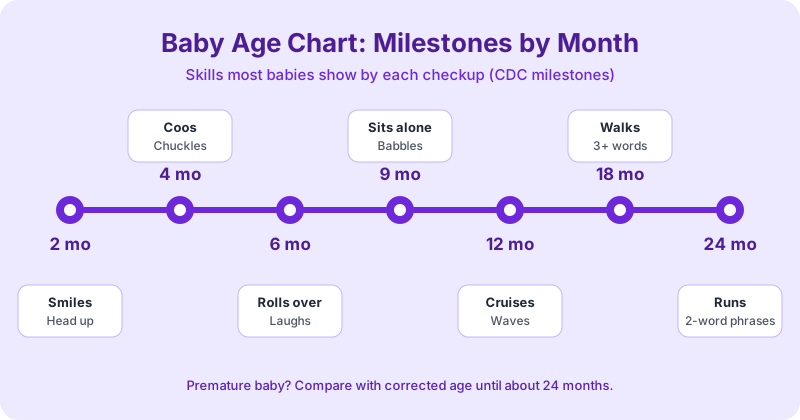
The skills below are examples of what many babies do at each age. They are grouped loosely in the style of the CDC “Learn the Signs. Act Early.” milestone checklists, which list skills that at least 75% of children show by each age and are a useful general reference for parents. A baby may reach some skills earlier and others later than shown.
| Age | Approx. weeks | Examples of skills many babies show |
|---|---|---|
| Newborn | 0 | Turns towards familiar voices, briefly focuses on faces close by, startles at loud sounds |
| 1 month | about 4 | Watches faces, makes small throaty sounds, lifts head briefly during tummy time |
| 2 months | about 9 | Smiles at people, calms when spoken to or picked up, holds head up during tummy time |
| 4 months | about 17 | Coos and makes sounds back, chuckles, brings hands to mouth, holds head steady when held |
| 6 months | about 26 | Laughs, reaches for toys, rolls from tummy to back, leans on hands when sitting |
| 9 months | about 39 | Sits without support, looks for dropped objects, babbles sounds like “mamama”, may be shy with strangers |
| 12 months | about 52 | Waves bye-bye, pulls up to stand, walks holding furniture, picks up small items with thumb and finger |
| 15 months | about 65 | Takes a few steps alone, points to ask for things, tries a word or two besides “mama” or “dada” |
| 18 months | about 78 | Walks without holding on, tries three or more words, tries to use a spoon, follows simple one-step directions |
| 24 months | about 104 | Kicks a ball, runs, puts two words together, points to things in a book when asked |
Find the row that matches your baby's completed months, not the month they are in. A baby born on January 10 is 4 months old from May 10 until June 9, so on May 25 you would read the 4-month row and look ahead to the 6-month row for what is coming next.
Milestones vary. This chart is general information, not medical advice. If you are worried about your baby's development, feeding, growth or health, speak to your paediatrician, GP or health visitor. Trust your instincts: you know your baby best, and it is always fine to ask.
When to talk to your pediatrician
Because the CDC checklists list skills most children already have by each age, a baby who has not reached one of them is worth mentioning at the next visit. Contact your doctor sooner if your baby loses skills they once had, does not respond to sounds, or does not make eye contact. The American Academy of Pediatrics recommends general developmental screening at the 9-, 18- and 30-month well-child visits, so those appointments are a natural time to bring the chart and your questions.
Baby age in weeks vs months
Months are not all the same length, so there is no exact number of weeks in a month. This table divides weeks by 4.345, the average number of weeks in a calendar month (365.25 days ÷ 12 months ÷ 7 days), and rounds to one decimal place. That is why 4 weeks is slightly less than one month and 52 weeks comes to 12 months.
| Weeks | Months (weeks ÷ 4.345) | In everyday terms |
|---|---|---|
| 0 | 0 | Newborn |
| 1 | 0.2 | First week |
| 2 | 0.5 | Two weeks old |
| 4 | 0.9 | Just under 1 month |
| 6 | 1.4 | About 6 weeks |
| 8 | 1.8 | Just under 2 months |
| 13 | 3.0 | 3 months |
| 17 | 3.9 | Just under 4 months |
| 26 | 6.0 | 6 months (half a year) |
| 35 | 8.1 | Just over 8 months |
| 39 | 9.0 | 9 months |
| 48 | 11.0 | 11 months |
| 52 | 12.0 | 12 months (1 year) |
| 65 | 15.0 | 15 months |
| 78 | 18.0 | 18 months (1½ years) |
| 91 | 20.9 | Just under 21 months |
| 104 | 23.9 | About 24 months (2 years) |
To convert any number of weeks yourself, divide by 4.345. To go the other way, multiply months by 4.345: 6 months is about 26 weeks and 9 months is about 39 weeks. For an exact figure based on real calendar dates, a calculator is quicker and avoids rounding.
How to calculate your baby's age
Your baby's age is counted from their actual date of birth. In the early weeks, count the number of full weeks since birth: a baby born 10 days ago is 1 week and 3 days old. From around three months onwards most people use months, counting complete calendar months from the birth date. A baby born on 15 March is 2 months old on 15 May and 3 months old on 15 June.
The months old calculator does this for you and shows the age in months, weeks and days from the date of birth. For an exact age in years, months and days, which is useful once your child is older, use the chronological age calculator.
Some growth charts and clinical forms plot age as a decimal rather than in months and days, for example 1.5 years instead of 18 months. If you need that format, the decimal age calculator converts a date of birth into age in decimal years.
Corrected age for premature babies
If your baby was born early, you may hear about two ages. Chronological age counts from the actual birth date. Corrected age, sometimes called adjusted age, takes away the weeks your baby was born early, so it reflects how old they would be if they had arrived on their due date.
Corrected age = chronological age − weeks born early. For example, a baby who is 16 weeks old and was born 6 weeks early has a corrected age of about 10 weeks. Corrected age is often the better guide when comparing development with a chart like the one above.
Correction is typically used until about 2 years of age, although your baby's healthcare team may advise differently, especially for babies born very early. The corrected age calculator works it out from the birth date and due date.
Baby Age Chart FAQ
Try Our Free Age Calculator
Calculate your exact age in years, months, and days — plus find your birthstone and zodiac sign.