If you just want the number, our chronological age calculator gives an exact age in years, months and days. If you need someone's age on the day a test was given, use the age at testing calculator. The rest of this article explains what chronological age means, how it is worked out by hand, and how it differs from the other kinds of "age" you will meet in medicine, psychology and education.
Chronological Age Meaning
The word chronological comes from the Greek chronos, meaning time. Chronological age is therefore age measured purely by the passage of time: the interval between a date of birth and a reference date, usually today. When someone says they are 30 years old, they are giving their chronological age.
Three features make it useful:
- It is objective. It depends only on two dates, so anyone with a birth certificate and a calendar will get the same answer.
- It is precise. It can be stated in whole years for everyday use, or down to the day when precision matters.
- It advances at the same rate for everyone. Nothing about health, ability or lifestyle changes it.
You will also see it called actual age, calendar age or chronologic age. In clinical reports it is often abbreviated CA.
How to Calculate Chronological Age
Chronological age is not simply the current year minus the birth year — that shortcut is wrong for anyone whose birthday has not yet come round this year. The reliable method counts complete units in order:
- Count the complete years from the date of birth to the most recent birthday.
- Count the complete months from that birthday to the most recent monthly anniversary of the birth date.
- Count the remaining days from that anniversary to the reference date.
Worked on paper, the same result is usually found by writing both dates in year / month / day columns and subtracting, borrowing days from the month column and 12 months from the year column whenever a column would go negative.
Worked Example
A child was born on 15 June 2012. How old are they on 3 October 2026?
| Step | Year | Month | Day |
|---|---|---|---|
| Reference date | 2026 | 10 | 3 |
| Borrow one month (30 days in September) | 2026 | 9 | 33 |
| Date of birth | 2012 | 6 | 15 |
| Difference | 14 | 3 | 18 |
The day column cannot subtract (3 − 15), so one month is borrowed. The month before October is September, which has 30 days, so the day column becomes 33 and the month column drops to 9. Now 33 − 15 = 18 days, 9 − 6 = 3 months and 2026 − 2012 = 14 years. The chronological age is 14 years, 3 months and 18 days.
Counting forward gives the same answer: 15 June 2012 to 15 June 2026 is 14 years; to 15 September 2026 is 3 more months; and 15 September to 3 October is 18 days. When the borrowed month has 28, 29 or 31 days, a method that always borrows a flat 30 days can differ from a true calendar count by a day or two, which is why assessment manuals state which convention to use.
Second Example: Before the Birthday
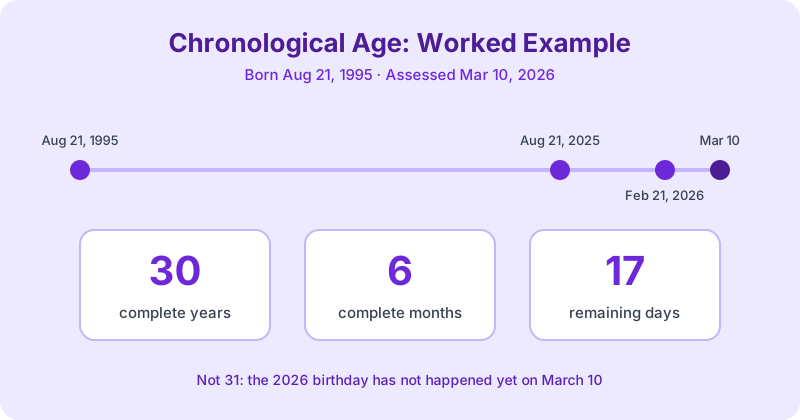
A person born on 21 August 1995 is assessed on 10 March 2026. Their 2026 birthday has not arrived yet, so they have completed 30 years (to 21 August 2025), then 6 months (to 21 February 2026), then 17 days (February 2026 has 28 days). The chronological age is 30 years, 6 months and 17 days — not 31, which is what 2026 − 1995 suggests. The same span is 11,159 days, or about 30.55 years as a decimal.
For more methods, including decimal age and total days, see the step-by-step guide on how to calculate age.
Chronological Age vs Biological Age
Biological age is an estimate of how old the body behaves, based on markers such as blood pressure, fitness, blood tests or DNA methylation patterns. Two people with the same chronological age can have quite different biological ages depending on genetics, health and lifestyle. Chronological age is a fact; biological age is an estimate that depends on the method used. For a fuller comparison, see chronological vs biological age.
Chronological Age vs Corrected (Adjusted) Age
For babies born prematurely — usually before 37 weeks of pregnancy — doctors and therapists often use a corrected age, also called adjusted age. It is the chronological age minus the number of weeks the baby arrived early. A baby born 8 weeks early who is 6 months old by the calendar has a corrected age of about 4 months. Corrected age is used to judge development fairly in the first years of life and is typically stopped somewhere around age two to three. Chronological age continues to be used for everything else. The corrected age calculator shows both figures side by side.
Chronological Age vs Mental or Developmental Age
In psychological and educational testing, chronological age is the yardstick other "ages" are compared against.
- Mental age describes the level of performance typical of a particular age. Early intelligence tests calculated a ratio IQ as mental age divided by chronological age, multiplied by 100. Modern tests use deviation scores instead, but they still need an exact chronological age to pick the right norms.
- Developmental age (or an age-equivalent score) describes the age at which a child's current skills are typical — for example, a 4-year-old whose language skills match those of a typical 3½-year-old.
A gap between chronological age and developmental age can help identify a delay, but only if chronological age itself was calculated correctly on the testing date. That is the job of an age at testing calculator.
Where Chronological Age Is Used
- School — enrolment and year-group placement usually depend on a child's age on a fixed cut-off date.
- Testing and assessment — standardized cognitive, speech-language and developmental tests select norms by exact age on the test date. Reports often write it as years;months (7;4 is 7 years 4 months); some manuals round up to the next month when 15 or more days remain, others truncate, so follow the specific manual. See the speech therapy age calculator and the child assessment age calculator.
- Medicine — growth charts, vaccination schedules, screening programmes and some dosing guidance are organised by age.
- Law — the ages for voting, driving, buying alcohol, signing contracts and drawing a pension, as well as the age of majority, are all defined by chronological age.
- Sport — youth and masters categories are usually set by age on a specific date or by birth year.
- Insurance and finance — premiums and eligibility often change at set ages.
Frequently Asked Questions
Summary
Chronological age is simply time since birth — objective, precise and the same for everyone. Other measures such as biological, corrected and developmental age are all interpreted against it. To work out an exact age without doing the borrowing by hand, use the chronological age calculator.