What age do babies crawl? Most babies start crawling between 7 and 10 months old, according to the American Academy of Pediatrics' guide to movement milestones. That is a wide window on purpose. A few babies are on the move at 6 months, many get going around 8 or 9 months, and some do not crawl until close to their first birthday. Some never crawl at all and still walk on time.
Short answer: the typical crawling age is 7 to 10 months. Babies usually sit without support first (by about 9 months), rock on their hands and knees for a few days or weeks, and then start moving forward. Skipping crawling is common and not a problem by itself, as long as your baby is finding some way to move and uses both arms and both legs.
Because "8 months" can mean very different things at different points in a month, it helps to know your baby's exact age. The months old calculator turns a birth date into completed months, weeks and days, which is the same way your pediatrician counts age at checkups.
What Age Do Babies Crawl? The Crawling Timeline by Month
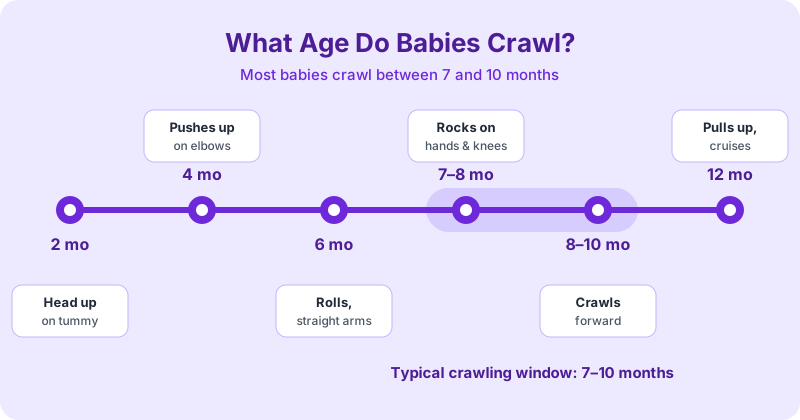
Crawling is the end of a long chain of smaller skills. Babies need head control, strong shoulders and arms, a stable trunk and the coordination to move opposite arms and legs together. The table below shows how those skills usually build up, month by month.
| Baby's age | What you will usually see | How it leads to crawling |
|---|---|---|
| 2 months | Holds head up during tummy time, moves both arms and both legs | Builds neck and upper-back strength |
| 4 months | Pushes up onto elbows and forearms on the tummy, holds head steady | Shoulders start to take weight |
| 6 months | Rolls from tummy to back, pushes up on straight arms, leans on hands while sitting | Arms can now support the upper body |
| 7–8 months | Pivots in circles on the tummy, scoots backward, gets onto hands and knees and rocks | Practice for moving forward |
| 8–10 months | Crawls forward on hands and knees, gets into a sitting position alone | Peak crawling age for most babies |
| 10–12 months | Crawls quickly, climbs onto low furniture, pulls up to stand and cruises | Crawling starts to give way to walking |
Notice that the backward scoot often comes first. Babies' arms are stronger than their legs at this age, so pushing with the arms sends them in reverse. Many parents see their baby "crawling" away from a toy for a week or two before forward movement clicks.
Signs Your Baby Is Getting Ready to Crawl
You can usually tell crawling is close a few weeks before it happens. Watch for these signs:
- Pushing up on straight arms during tummy time and lifting the chest well off the floor.
- Sitting without support and leaning forward to reach a toy, then catching themselves with their hands.
- Moving from sitting to the tummy and back again. This transition is one of the clearest signs that crawling is near.
- Rocking on hands and knees. Babies often get into the crawling position and rock back and forth before they work out how to move a hand forward.
- Pivoting and scooting. Turning in a circle on the tummy or sliding backward shows the muscles are ready, even if the direction is not.
Once rocking starts, crawling forward often follows within a few weeks. Every baby is different, though, and some rock for longer before they get going.
Types of Baby Crawling Styles
The classic hands-and-knees crawl is not the only way babies get around. All of these are normal, as long as your baby uses both sides of the body:
Classic crawl
The baby moves on hands and knees, with the opposite arm and leg moving together. This is the pattern most people picture.
Commando or belly crawl
The baby keeps the tummy on the floor and pulls forward with the arms, sometimes pushing with the legs. Many babies belly crawl first and lift onto their knees later.
Bottom scoot
The baby stays sitting and shuffles forward on the bottom, often pushing with one or both legs. Bottom scooters sometimes walk a little later than classic crawlers, and that is usually fine.
Bear crawl and crab crawl
In the bear crawl, the baby moves on hands and feet with straight legs and the bottom in the air. In the crab crawl, the baby moves sideways or backward using the arms. Both are just different ways of solving the same problem.
Pediatricians care less about the style and more about two things: is your baby finding a way to explore, and are both sides of the body doing the work?
Is It Normal if My Baby Skips Crawling?
Yes. A real share of babies never crawl in the classic sense. They roll, scoot, or go straight from sitting to pulling up and cruising along furniture. The AAP notes that a few children never crawl and use other methods instead, and that this is not a concern as long as the baby moves both sides of the body equally.
That is also why the CDC's milestone checklists, updated in 2022, do not list crawling as a milestone on its own. The checklists focus on skills that at least 75% of children show by a given age, such as sitting without support by 9 months and pulling up to stand by 12 months. You can read the full lists on the baby age chart, which follows the CDC checklists from birth to 24 months.
Babies who skip crawling still need floor time. Moving on the floor builds the shoulder, hip and core strength that later supports walking, climbing and even fine motor skills like holding a crayon.
Crawling Age for Premature Babies
If your baby was born before 37 weeks, judge crawling by corrected age, not by birth date. Corrected age is actual age minus the number of weeks your baby arrived early.
For example, a baby born 8 weeks early who is 10 months old by the calendar has a corrected age of about 8 months. That baby is right in the normal window for crawling, even though a friend's full-term 10-month-old may already be cruising. Doctors usually use corrected age for development until about age 2.
The corrected age calculator works this out from the birth date and due date, so you can compare your baby with the right part of the crawling timeline.
How to Help Babies Crawl
You cannot rush crawling, but you can give your baby plenty of chances to practice:
- Give daily tummy time from the first weeks, always while your baby is awake and supervised. Short, frequent sessions add up.
- Put toys just out of reach so your baby has a reason to stretch, pivot and push forward.
- Get down on the floor with them. Your face is the most interesting thing in the room, so lie a short distance away and call your baby to you.
- Limit time in containers like bouncers, swings, car seats outside the car and baby walkers. The AAP advises against baby walkers because of injury risk, and they do not help babies learn to walk.
- Use a safe, firm surface. A play mat or rug gives better grip than a soft bed or a slippery floor.
- Let them go barefoot indoors when it is warm enough, so their feet and knees can grip.
Babyproofing Before Your Baby Crawls
Crawling babies move faster than most parents expect, and they head straight for anything interesting. Babyproof before crawling starts, not after:
- Install safety gates at the top and bottom of stairs.
- Cover electrical outlets and tuck cords out of reach.
- Anchor bookcases, dressers and TVs to the wall.
- Move cleaning products, medicines and button batteries up high or behind locked cabinets.
- Get down to your baby's eye level and look for small objects that could be a choking hazard.
When to Talk to Your Doctor About Crawling
A late start on its own is rarely a problem. These signs are worth raising with your pediatrician:
- Your baby is not moving across the floor in any way (crawling, scooting or rolling) by about 12 months, or 12 months corrected age for a preemie.
- Your baby cannot sit without support by 9 months.
- Your baby uses one arm or one leg much more than the other, or drags one side while crawling.
- Your baby seems very stiff or very floppy.
- Your baby has lost a movement skill they used to have.
A pediatrician can check muscle tone and strength and refer your child to early intervention or a physical therapist if needed. Early support works best, so trust your instincts and ask. Do not wait to see if your baby catches up.
After Babies Crawl: Pulling Up and Walking
Crawling is usually a short phase. Within a few weeks to a few months, most babies start pulling up on furniture, cruising sideways while holding on, and then taking their first steps. By 15 months, the CDC lists taking a few steps alone as a milestone, and by 18 months most children walk without holding on.
Language develops alongside movement. Crawling babies are often babbling "mamama" and "bababa" too. To see how speech develops over the same months, read the next article in this series, what age do babies start talking.
What Age Do Babies Crawl? FAQ
What is the earliest age a baby can crawl?
Some babies start crawling at 6 months, and a few begin even earlier. Early crawling is not a sign of anything special, just as later crawling is not a sign of a problem.
What is the latest age a baby should crawl?
There is no hard cutoff, because some babies skip crawling. If your baby is not moving across the floor in any way by about 12 months, talk to your pediatrician.
Does crawling late mean my baby will walk late?
Not necessarily. Some late crawlers walk right on time, and some babies who skip crawling walk early. The range for first steps is wide, from about 9 to 18 months.
Is it bad if my baby only crawls backward?
No. Backward crawling is a normal early stage, because the arms are stronger than the legs at first. Most babies work out how to go forward within a few weeks.
More Baby Crawling and Age Guides
Track your baby's age and milestones with these guides and tools:
This article is general information about typical development. It is not medical advice. If you have concerns about your child's development, talk to your pediatrician.