Biological Age vs Chronological Age: The Short Answer
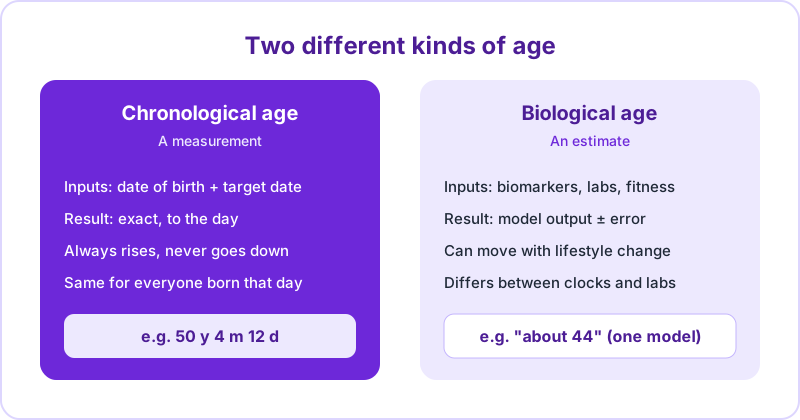
Chronological age is the calendar time that has passed since your date of birth. It is a measurement — fixed, objective and identical for everyone born on the same day. Biological age is an estimate of how well your body is functioning relative to typical function at various calendar ages. It is a model output, not a measurement, and it changes depending on which model you use.
| Chronological age | Biological age | |
|---|---|---|
| What it measures | Time elapsed since birth | Estimated physiological condition of the body |
| Inputs needed | Date of birth and a target date | Biomarkers, lab results or fitness measures |
| Precision | Exact, to the day | An estimate with a margin of error |
| Can it go down? | No | Estimates can fall with lifestyle change |
| Used for | Records, legal age, test norms, eligibility | Health research, wellness and risk discussion |
| Same for identical twins? | Always | Not necessarily |
Both are useful; they simply answer different questions. "How long have I been alive?" is chronological. "How well is my body holding up?" is biological.
Your chronological age
Why there is no biological age calculator here. Biological age cannot be derived from a date of birth. Any honest estimate needs physiological inputs — blood work, DNA methylation data or measured fitness — so a tool that asks only for your birthday and returns a "body age" is producing a chronological age with decoration. This page explains the concept and calculates the number that can actually be calculated.
What Is Chronological Age?
Chronological age is the elapsed calendar time between your date of birth and a chosen date, normally today. It is worked out by simple subtraction:
Chronological Age = Target Date − Date of Birth
Expressed properly it has three parts — complete years, then complete months, then remaining days — which is why 34 years, 2 months and 11 days is more informative than "34". Leap years and unequal month lengths are handled by counting whole calendar months first and only then counting the leftover days, which is the method used in legal and administrative contexts worldwide. Our guide to how to calculate age works through the borrowing method by hand, and what chronological age means covers the definition in more depth.
Because it is a pure measurement, chronological age is what appears on records, forms and identification, and what determines legal eligibility, school placement and the norms table used for a standardized test.
What Is Biological Age?
Biological age — also called physiological age or body age — estimates how old your body appears to be, based on how well it is functioning compared with reference populations. A 50-year-old whose cardiovascular fitness, metabolic markers and cellular measures resemble a typical 35-year-old would be described as having a biological age near 35.
It is a research construct rather than a fixed quantity, and different estimators disagree with one another. Two labs analysing the same blood sample with different clocks can return biological ages several years apart, which is why the direction of change over time is usually more meaningful than any single number.
What Influences Biological Age Estimates
- Genetics — some people are predisposed to slower cellular ageing.
- Physical activity — among the strongest and most consistent associations in the literature.
- Diet — nutrient-dense, largely anti-inflammatory eating patterns are associated with lower estimates.
- Sleep — chronic short or fragmented sleep tracks with accelerated markers.
- Chronic stress — associated with shorter telomeres and higher inflammatory markers.
- Smoking and heavy alcohol use — both strongly associated with higher estimates.
How Is Biological Age Estimated?
There is no single accepted method. The main families of approach are:
- Epigenetic clocks — patterns of DNA methylation change predictably with age. The Horvath clock and later clocks such as GrimAge and PhenoAge are widely used in research.
- Telomere length — the protective caps on chromosomes shorten as cells divide. Simple to describe, but noisy at the individual level.
- Blood biomarker panels — combinations of inflammatory markers, metabolic markers, kidney and liver function and blood counts, fitted against age in a reference population.
- Functional measures — grip strength, walking speed, VO₂ max and lung capacity, used as proxies for overall physiological condition.
- Lifestyle questionnaires — the fastest and least precise family; useful as a prompt for reflection, not as a measurement.
All of these need data about your body. None of them can run on a birth date alone, which is the practical difference between a biological age calculator and a chronological age calculator.
Can Your Biological Age Be Younger Than Your Chronological Age?
Yes — estimates routinely land above or below calendar age, and a gap in either direction is common. Research consistently associates lower estimates with regular physical activity, adequate sleep, not smoking, moderate or no alcohol use and lower long-term inflammation, and there is evidence that sustained lifestyle change can move the markers.
Two cautions are worth keeping in mind. First, the size of the gap depends on the estimator, so a "seven years younger" result from one test is not comparable to a result from another. Second, biological age is an average over many systems; a favourable overall estimate does not rule out a specific problem, and an unfavourable one is not a diagnosis. Discuss anything that concerns you with a clinician rather than acting on an online score.
Biological Age Calculator vs Chronological Age Calculator
| Chronological age calculator | Biological age calculator | |
|---|---|---|
| Input | Date of birth and a target date | Biomarkers, lab panels or fitness data |
| Output | Exact years, months and days | An estimated age with uncertainty |
| Repeatable | Identical every time | Varies by method and by sample |
| Accepted for records | Yes | No |
| Available on this site | Yes — the calculator above | No, and deliberately so |
If a site offers a "biological age calculator" that asks only for your birthday, it is returning your chronological age. If it asks a handful of lifestyle questions, treat the answer as a conversation starter. Genuine estimates come from lab or clinical data.