What is decimal age?
Decimal age expresses age as one continuous number instead of separate years, months, and days. For example, 12.5000 years means approximately halfway between the twelfth and thirteenth birthdays. This format can be convenient in research, data analysis, statistics, and spreadsheets, because a single number is easy to sort, average, and plot.
It is still chronological age: the time elapsed since birth. Decimal age is simply a different way of writing it. If you need the familiar years, months and days format instead, use the chronological age calculator.
Formula used
This calculator divides the number of elapsed calendar days by 365.2425, the average length of a year in the Gregorian calendar, which adds a leap day every four years but skips three leap days every 400 years. The main result is shown to four decimal places, with a two-decimal version for situations that need less precision.
Decimal age = days since birth ÷ 365.2425
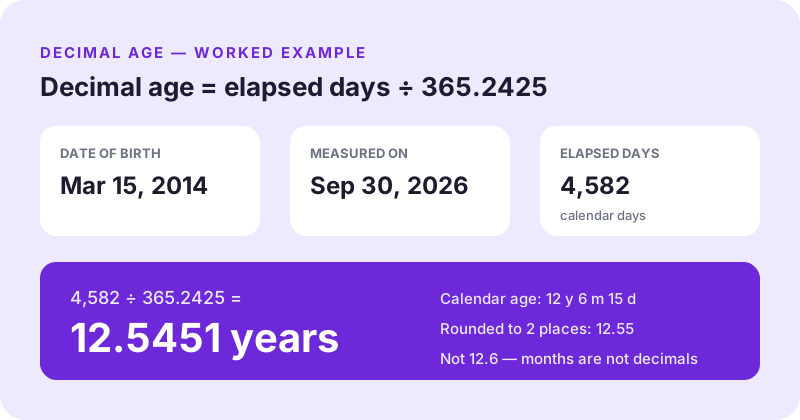
In the example above, a child born on 15 March 2014 has lived 4,582 days on 30 September 2026: 4,582 ÷ 365.2425 = 12.5451, or 12.55 to two decimals. Their calendar age is 12 years, 6 months and 15 days.
Decimal age is not the same as writing calendar months after a decimal point. An age of 12 years and 6 months is approximately 12.5 years, not 12.6 years.
When another convention is required
A study, test publisher, institution, or software system may prescribe a different denominator, reference time, rounding method, or treatment of leap days. Some growth charts and statistical packages divide by 365.25 days rather than 365.2425; the difference is tiny, usually affecting only the fourth decimal place. Use the formula specified by that authority when the result is used professionally. This general calculator does not replace a formal protocol.
Worked example: calculating decimal age by hand
Take a child born on 14 March 2015, measured on 5 October 2026.
- Count the days between the two dates: 4,223 days.
- Divide by the average year length: 4,223 ÷ 365.2425 = 11.5622.
- Round to two decimal places: 11.56 years.
As a check, the same span is 11 years, 6 months and 21 days. Six months is 0.50 of a year and 21 days is about 0.06, which also gives about 11.56. Dividing by 365.25 instead gives 11.5619, which still rounds to 11.56. To find age on a past or future date rather than today, use the age on date calculator, and see how to calculate age for the step-by-step calendar method.
Months to decimal age conversion table
To convert years and months to decimal age, divide the months by 12 and add the result to the whole years. For example, 5 years 9 months = 5 + 0.75 = 5.75 years.
| Months | Fraction | Decimal (4 dp) | Decimal (2 dp) |
|---|
| 1 month | 1/12 | 0.0833 | 0.08 |
| 2 months | 2/12 | 0.1667 | 0.17 |
| 3 months | 3/12 | 0.2500 | 0.25 |
| 4 months | 4/12 | 0.3333 | 0.33 |
| 5 months | 5/12 | 0.4167 | 0.42 |
| 6 months | 6/12 | 0.5000 | 0.50 |
| 7 months | 7/12 | 0.5833 | 0.58 |
| 8 months | 8/12 | 0.6667 | 0.67 |
| 9 months | 9/12 | 0.7500 | 0.75 |
| 10 months | 10/12 | 0.8333 | 0.83 |
| 11 months | 11/12 | 0.9167 | 0.92 |
Month-based conversions are approximate because calendar months vary from 28 to 31 days. The day-count method used by the calculator is more precise. For very young children, age in months is often more practical; the months old calculator gives that directly.
Where decimal age is used
Schools and educational testing
Schools, particularly in the UK, often record pupil age in decimal years or in years and months when looking up standardised scores, comparing reading age with actual age, or grouping pupils for analysis. A decimal number makes it easy to compare a pupil's age with a reading age or to sort a class list in a spreadsheet. Always follow the age format and test date rules given in the test manual.
Paediatric growth charts
Growth charts such as the UK-WHO charts produced by the RCPCH plot height, weight and head circumference against age, and many clinical systems calculate decimal age to place a measurement accurately between whole years. For babies born prematurely, clinicians typically plot against corrected age for the early months; the corrected age calculator handles that adjustment, and the baby age chart shows common age milestones in weeks and months.
Sport and athlete development
Youth sport usually groups players by birth year or a cut-off date, so children in the same group can be almost a year apart in age. Coaches and researchers studying the relative age effect use decimal age to see exactly how old each player is relative to the cut-off and to their teammates.
Research and statistics
Studies in health, psychology and the social sciences often store age as a decimal variable. A continuous number can be averaged, used in regression models and plotted without converting mixed units, and it avoids the information lost when age is rounded down to whole years.
Decimal age vs years-and-months age
| Decimal age | Years and months |
|---|
| Example | 11.56 | 11 years 6 months |
| Best for | Charts, spreadsheets, statistics | Reports, conversation, test forms |
| Precision | Set by decimal places | Usually to the month or day |
| Easy to read at a glance | Less familiar | Yes |
Both formats describe the same age. Choose the one your chart, test or system expects, and avoid mixing them: 9.10 decimal years is about 9 years 1 month, not 9 years 10 months.
Frequently asked questions
What is decimal age?
Decimal age is age written as one number in years, with the part of the current year shown as a decimal fraction. A child who is 8 years and 6 months old has a decimal age of about 8.50.
How do you calculate decimal age?
Count the days between the date of birth and the date of interest, then divide by the length of a year. This calculator uses 365.2425 days, the average Gregorian year. For example, 4,223 days divided by 365.2425 gives 11.56 years.
What decimal age should I use for growth charts?
Growth charts plot measurements against decimal age so a point can sit between whole years. Use the age on the day the measurement was taken. For babies born early, check whether the chart or clinician expects corrected age instead of chronological age.
How do I convert months to decimal age?
Divide the extra months by 12 and add the result to the whole years. For example, 7 years and 3 months is 7 + 3 ÷ 12 = 7.25 years. Remaining days can be added as days ÷ 365.2425.
Is decimal age the same as chronological age?
Decimal age is a way of writing chronological age. Chronological age is the time elapsed since birth; it can be written as years, months and days, or as a single decimal number. Both describe the same span of time.
Why is 12 years 6 months not 12.6?
Months are twelfths of a year, not tenths. Six months is 6 ÷ 12 = 0.5, so 12 years 6 months is about 12.5 decimal years.
Why divide by 365.2425 instead of 365?
Dividing by 365 would slowly overstate age, by about one day for every four years lived. The value 365.2425 is the average Gregorian year length once leap-year rules are included, so the result stays accurate over long spans.
Does the decimal age change every day?
Yes. Each calendar day adds about 0.0027 years (1 ÷ 365.2425), so a four-decimal result changes daily. The two-decimal version changes roughly every three to four days.
Can I calculate decimal age on a past date?
This tool measures to today, using the date set on your device. For a test or measurement date, find the exact age and total days with the age on date calculator, then divide those total days by 365.2425.