Chronological age
Corrected (adjusted) age
Educational estimate — not medical advice. This calculator is not a medical device and does not diagnose, treat or assess anything. Definitions of full term, the figure to subtract, rounding and the age at which adjustment stops all vary by clinician and purpose. Do not use this result for diagnosis, medication, feeding, emergency decisions or interpreting development without a qualified paediatric professional. If you are unsure of the due date or gestational age, use the figure documented by the baby's healthcare team.
What Is Corrected Age?
Corrected age — also called adjusted age — is a premature baby's age counted from the expected due date rather than the actual date of birth. It answers a different question from chronological age: not "how long has this baby been alive?" but "how old would this baby be if they had arrived at term?"
The distinction matters because developmental milestones — rolling over, sitting, babbling, first words — track development that began before birth. A baby born ten weeks early has had ten fewer weeks of that development than a term baby of the same chronological age, and comparing them directly makes the preterm baby look delayed when they may be developing exactly as expected.
Both numbers stay true at once. A baby can be eight months old chronologically and six months corrected on the same day. Birthdays, paperwork and legal age always use the chronological figure; developmental expectations often use the corrected one.
The Formula
Corrected age = chronological age − weeks born early
Or, equivalently and more precisely: corrected age = calculation date − expected due date. The second form is what the calculator above uses when you supply a due date, because it avoids compounding rounding errors from converting weeks into months.
Weeks born early is normally 40 weeks − gestational age at birth. A baby born at 32 weeks was 8 weeks early; a baby born at 28 weeks and 3 days was 11 weeks and 4 days early.
Worked Example
A baby is born on 1 March at 31 weeks gestation — nine weeks before the 40-week reference point, so the expected due date was 3 May.
| On this date | Chronological age | Corrected age |
|---|---|---|
| 1 May | 2 months | Not yet at due date |
| 3 July | 4 months, 2 days | 2 months |
| 3 November | 8 months, 2 days | 6 months |
| 3 May, one year later | 1 year, 2 months, 2 days | 1 year |
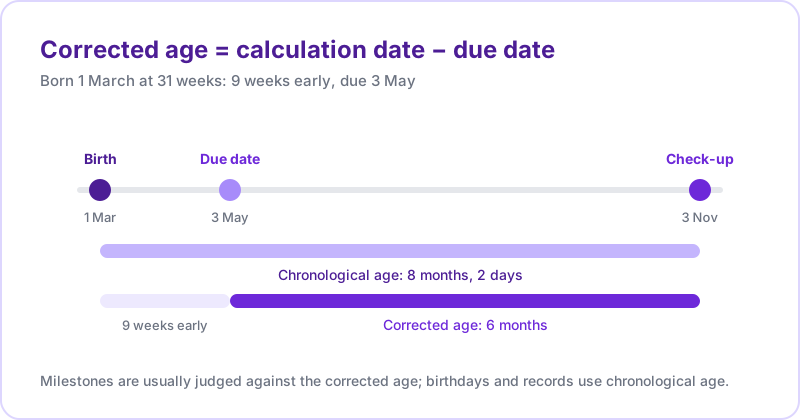
The nine-week gap never closes on its own — it is only ever set aside, by a clinical decision to stop correcting. Note that before the due date arrives the corrected age is negative in principle; in practice it is simply reported as "not yet at term" or in weeks of postmenstrual age, which is how neonatal units usually describe babies still in hospital.
Chronological vs Corrected Age at a Glance
| Chronological age | Corrected / adjusted age | |
|---|---|---|
| Counted from | Actual date of birth | Expected due date |
| Applies to | Everyone | Usually births before 37 weeks gestation |
| Used for | Birthdays, forms, legal age, most test norms | Developmental milestones, growth charts, some early screening |
| When it stops | Never | Commonly 24 months, sometimes 36 months for very preterm babies |
| Also called | Actual age, calendar age | Adjusted age, age corrected for prematurity |
When Corrected Age Is Used — and When It Is Not
Commonly corrected
- Developmental milestones in the first two years — motor, language and social expectations.
- Growth charts for weight, length and head circumference in early infancy.
- Some early intervention screening, where the protocol explicitly provides for adjustment.
- Feeding and sleep expectations discussed with a paediatric team.
Usually not corrected
- Immunisation schedules, which are normally given by chronological age.
- Legal and administrative age — school entry dates, forms, identification.
- Most standardized test norms, unless the manual says otherwise.
- Birthdays, which follow the actual date of birth.
Because the rules differ from one protocol to the next, the safest approach is to record both figures and let the instrument or clinician decide which applies. For assessments in particular, see the chronological age calculator for child assessments and the speech therapy age calculator, both of which report the chronological figure that most manuals expect.
The American Academy of Pediatrics explanation of corrected age for preemies is a good plain-language starting point for parents.