Chronological age on the assessment date
Follow the instrument's own manual. This tool performs a calendar calculation only. Age intervals, cut-points, rounding and prematurity adjustment rules are defined by each publisher and must be taken from the official materials. This site is independent and is not affiliated with or endorsed by ASQ, BRIGANCE, Gesell or any other publisher.
Why a Child Assessment Age Calculator Matters
Every developmental screening starts from the same number: the child's chronological age on the day the assessment is administered. That figure decides which questionnaire interval, age band or item set applies, and every cut-point that follows is read from it. A child who is 23 months and 27 days is not scored the same way as a child who is 24 months and 3 days, even though both are "nearly two".
The arithmetic is a plain calendar subtraction:
Chronological Age = Assessment Date − Date of Birth
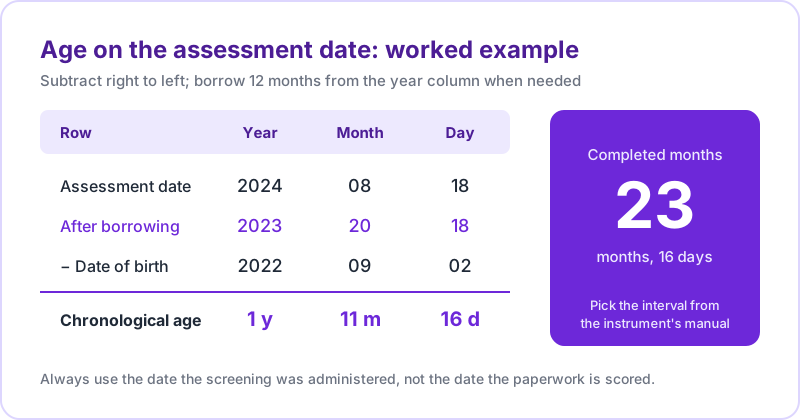
Working it by hand means writing both dates in year / month / day columns and subtracting right to left, borrowing 30 days from the month column and 12 months from the year column whenever a column would go negative. The calculator above does the borrowing for you and also reports the total age in months, which is the unit most screening tools ask for.
Worked Example
A child born 2 September 2022 is screened on 18 August 2024. The day column subtracts cleanly (18 − 2 = 16), but the month column cannot (8 − 9), so one year is borrowed as twelve months and 2024/08 becomes 2023/20. That leaves 2023 − 2022 = 1 year and 20 − 9 = 11 months. The result is 1 year, 11 months, 16 days — or 23 months completed. A screener that switches interval at 24 months would still use the 22–24 month materials for this child.
Age for Specific Screening Tools
ASQ Age Calculation
The Ages & Stages Questionnaires (ASQ-3 and ASQ:SE-2) are organised into questionnaire intervals defined by age in months and days. Selecting the correct interval depends on the child's exact age on the day the questionnaire is completed, and the ASQ system publishes its own guidance on adjusting for prematurity. Use the calculator above to establish the calendar age, then choose the interval from the official ASQ age-administration chart. ASQ is published by Brookes Publishing; this site is not affiliated with it.
Age for BRIGANCE Assessments
BRIGANCE screens and inventories report results against age expectations, so an accurate administration-date age is needed before any scoring or cut-off comparison. The precise age bands and any rounding conventions are set out in the BRIGANCE manual for the edition you are using. BRIGANCE is published by Curriculum Associates; this site is not affiliated with it.
Age for Gesell Assessments
Gesell developmental observation materials are also age-referenced, and practitioners typically record chronological age in years and months alongside the observation date. Establish the calendar age first, then apply the Gesell materials' own conventions. Gesell is a trademark of its owner; this site is not affiliated with it.
Other Age-Referenced Instruments
The same calculation applies to any age-normed instrument — cognitive screeners, motor scales, early literacy checks and school-readiness batteries. If the assessment is a speech or language test specifically, the speech therapy age calculator covers the years;months reporting conventions SLPs use. For school-age cognitive or achievement tests, the age at testing calculator covers the general case, and the Pearson age calculator alternative explains when a publisher's own scoring tool is the better choice.
When Corrected Age May Matter
Children born preterm are sometimes assessed against a corrected age — chronological age minus the number of weeks born before the expected due date. Whether to correct is decided by the instrument's protocol, not by the person doing the arithmetic.
| Chronological age | Corrected age | |
|---|---|---|
| Starting point | Actual date of birth | Expected due date |
| Who it applies to | Every child | Usually births before 37 weeks gestation |
| Typical use | Eligibility, placement, most standardized norms | Interpreting early developmental milestones |
| When it stops | Never — it keeps counting | Commonly between 24 and 36 months |
When a protocol does call for an adjustment, the corrected age calculator reports chronological and corrected age side by side from a date of birth and a due date. The American Academy of Pediatrics guidance on corrected age explains why the distinction exists.
How to Calculate Age on the Testing Date Accurately
- Read the date of birth from the record, not from memory or from a previous report that may itself contain a typo.
- Use the administration date. Completing paperwork a week later does not change how old the child was during the session.
- Watch the date format. 03/04/2024 is 3 April in the UK and Australia and 4 March in the United States. The calculator on this page uses a named month specifically to remove that ambiguity, so it can be used from any country without conversion.
- Recalculate at every re-screen. Adding twelve months to a previous figure fails whenever the anniversary has not yet passed.
- Record the age in the units the instrument uses — completed months for most screeners, years;months for most standardized tests.
- Cross-check borderline cases. If the child is within a few days of an interval boundary, verify the dates a second time before selecting materials.
Sources and Test Manuals
This child assessment age calculator supplies the calendar age only. Questionnaire intervals, age bands, rounding, the handling of remaining days and whether — and until when — to correct for prematurity are all defined in each instrument's own user's guide or examiner's manual. If the manual and this page disagree, the manual governs.
Manuals to check include:
- ASQ-3 and ASQ:SE-2 (Ages & Stages Questionnaires) user's guides — Brookes Publishing
- BRIGANCE Early Childhood screens and inventories — Curriculum Associates
- Gesell Developmental Observation examiner materials and guidance
- Bayley-4 (Bayley Scales of Infant and Toddler Development, Fourth Edition) — Pearson
Use the edition that matches the forms you are completing, and follow any additional local programme guidance. This site is not affiliated with any of these publishers.