Most babies say their first real word around their first birthday, usually somewhere between 10 and 15 months. But talking does not start with a word. Long before that, babies coo, squeal, babble and use gestures to tell you what they want. Each of those steps is part of learning to talk, and each one has a typical age.
Short answer: babies coo by about 4 months, babble strings like "mamama" and "bababa" by about 9 months, and say "mama" or "dada" for a parent by about 12 months. By 18 months most toddlers try three or more words, by 2 years they put two words together, and by 30 months they say about 50 words.
The milestones below follow the CDC's "Learn the Signs. Act Early." checklists and the National Institute on Deafness and Other Communication Disorders guide to speech and language milestones. To see exactly which stage applies to your child today, work out their age with the months old calculator.
What Age Do Babies Start Talking? The Speech Timeline
Speech grows in layers. Babies first learn that sounds get a response, then practice the sounds of their language, then link those sounds to meaning. This table shows when each layer usually appears.
| Age | Typical talking milestones |
|---|---|
| 2 months | Makes sounds other than crying, reacts to loud sounds |
| 4 months | Coos ("oooo", "aahh"), makes sounds back when you talk, turns toward your voice |
| 6 months | Takes turns making sounds with you, blows "raspberries", squeals |
| 9 months | Babbles many different sounds like "mamamama" and "bababababa", lifts arms to be picked up |
| 12 months | Waves bye-bye, calls a parent "mama", "dada" or another special name, understands "no" |
| 15 months | Tries one or two words besides "mama" or "dada" (like "ba" for ball), points to ask for things |
| 18 months | Tries three or more words besides "mama" or "dada", follows one-step directions without gestures |
| 2 years | Says at least two words together, like "more milk", points to things in a book when asked |
| 30 months | Says about 50 words, uses an action word in two-word phrases ("doggie run"), says "I", "me" or "we" |
| 3 years | Holds a conversation with at least two back-and-forth exchanges, asks "who", "what", "where" or "why" |
These are the skills that at least 75% of children show by each age. That means many children reach them earlier, and a child who is a little behind on one item is not automatically delayed.
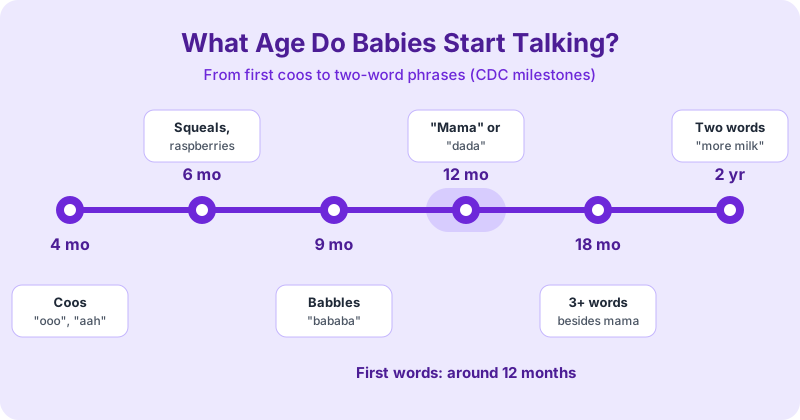
From Cooing to Babbling: Talking Before Words
Cooing (about 2 to 4 months)
Cooing is a baby's first deliberate sound play. You will hear soft vowel sounds like "ooo" and "aah", often when your baby is calm and looking at your face. When you coo back, your baby learns the most important rule of conversation: you take turns.
Squeals, laughs and raspberries (about 4 to 6 months)
Around 6 months, babies experiment with their voice and mouth. They squeal, laugh, growl and blow raspberries. It sounds silly, but it is practice for controlling breath, lips and tongue, all of which they will need for speech.
Babbling (about 6 to 9 months)
Babbling is when babies string consonants and vowels together: "bababa", "dadada", "mamama". By 9 months, the CDC milestone is making a lot of different sounds like these. Babbling slowly starts to take on the rhythm and tone of the language around your baby, which is why it can sound like your baby is asking a question or telling a story.
Gestures (about 9 to 12 months)
Gestures are a big step toward words. Lifting arms to be picked up, waving bye-bye and pointing all show that your baby knows they can send a message on purpose. Babies who gesture a lot usually have a lot to say once the words come.
When Do Babies Say Their First Word?
Most babies say a first real word around 12 months. A word counts when your baby uses the same sound for the same thing on purpose. It does not have to be pronounced correctly. "Ba" for ball, "wawa" for water and "uh-oh" when something falls are all real words.
"Mama" and "dada" are often first, because the sounds are easy and parents react so happily. Babbling "mamama" at 8 months is still practice. Turning toward you and calling "mama" when they want you, usually by about 12 months, is a word.
After the first word, new words tend to come slowly for a few months. By 15 months, most babies try one or two words besides "mama" or "dada". By 18 months, they try three or more. Then, for many children, vocabulary takes off between 18 months and 2 years, sometimes called the word spurt.
Toddler Talking: Phrases and Sentences
Once babies start talking in single words, the next step is combining them. By 2 years, the CDC milestone is saying at least two words together, like "more milk" or "daddy go". By 30 months, most children say about 50 words and use phrases with an action word, like "doggie run". By 3 years, children can usually hold a short conversation and ask "what" and "why" questions.
Understanding comes before speaking at every stage. A 15-month-old who says only a couple of words may understand dozens, look at a familiar object when you name it, and follow directions like "give me the toy" when you hold out your hand. If your child understands a lot and uses gestures well, that is a good sign even if spoken words are still few.
Premature Babies and Talking Age
For babies born before 37 weeks, use corrected age when you compare speech to the timeline. Corrected age is actual age minus the number of weeks your baby was born early. A baby born 6 weeks early who is 13 months old by the calendar is about 11.5 months corrected, so not having a first word yet is still within the normal range.
Doctors usually use corrected age until about age 2. The corrected age calculator works it out from the birth date and due date.
What Affects When Babies Start Talking?
- Hearing. Babies learn to talk by listening. Even mild hearing loss from repeated ear infections can slow speech, which is why newborn hearing screening and follow-up matter.
- How much they are talked to. Back-and-forth conversation, even with a baby who only coos, is one of the strongest predictors of language growth.
- Temperament. Some children wait until they can say a word well before using it. Others try everything early.
- Other skills developing at the same time. Babies sometimes put speech on hold while they focus on a big motor skill like crawling or walking. Our guide on what age do babies crawl covers that timeline.
- Family history. Late talking sometimes runs in families.
Do bilingual babies talk later?
No. Children raised with two languages reach the main language milestones within the normal range. They may know fewer words in each language at first, but their total vocabulary across both languages is usually similar to that of children learning one language. Speaking your own strongest language at home is the best choice.
How to Help Your Baby Start Talking
- Talk through your day. Describe what you are doing: "Now we put on your socks. One sock, two socks."
- Respond to every sound. When your baby coos or babbles, answer and then pause so they can "reply".
- Read together every day. Point to pictures and name them. Board books with one picture per page are ideal for babies.
- Sing songs and nursery rhymes. Repetition and rhythm help babies pick out sounds and words.
- Add one word. If your toddler says "ball", you say "big ball" or "red ball". This models the next step without correcting them.
- Give them a reason to talk. Offer a choice ("apple or banana?") and wait a few seconds before helping.
- Limit screen time. The AAP recommends avoiding screen media other than video chatting for children younger than 18 to 24 months. Live conversation teaches language far better than video.
When to Talk to a Doctor About Late Talking
Every child develops at their own pace, but it is worth talking to your pediatrician if your child:
- Does not respond to loud sounds or turn toward voices by about 4 to 6 months.
- Is not babbling by about 9 months.
- Does not use gestures like pointing or waving by about 12 months.
- Is not saying single words by about 15 to 16 months.
- Is not putting two words together by 2 years.
- Loses words or skills they used to have, at any age.
Your doctor may check your child's hearing first and may refer you to a speech-language pathologist. In the US, children under 3 can also be evaluated through your state's early intervention program, often at no cost. The speech therapy age calculator shows how therapists calculate age for these assessments. Early help makes a real difference, so do not wait to see if your child grows out of it.
What Age Do Babies Start Talking? FAQ
Can a baby talk at 6 months?
Babies at 6 months make lots of sounds, squeal and take turns "talking" with you, but real words are rare this early. Repeated syllables like "dada" at this age are babbling, not words yet.
Is it normal for a 1-year-old not to talk?
Yes, many 1-year-olds have no clear words yet. Look at the other skills: babbling with different sounds, waving, pointing, and understanding simple words like "no". If those are present, a first word usually follows soon.
Do boys talk later than girls?
On average, girls tend to start talking slightly earlier, but the difference is small and the ranges overlap a lot. Do not use gender as a reason to wait if you have concerns.
How many words should an 18-month-old say?
The CDC milestone at 18 months is trying to say three or more words besides "mama" or "dada". Many 18-month-olds say more than that, often 10 words or more.
More Baby Talking and Age Guides
Keep track of your baby's age and development with the rest of the series:
This article is general information about typical development. It is not medical advice. If you have concerns about your child's speech or hearing, talk to your pediatrician.