How the Age Difference Calculator Works
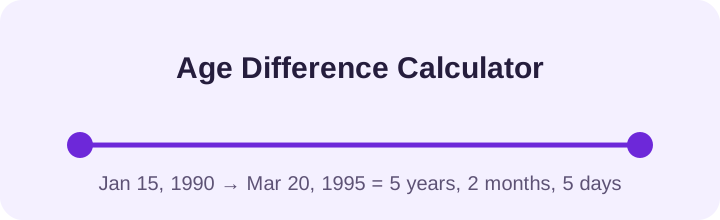
The age difference between two people is the calendar interval between their two dates of birth. Unlike an age, an age gap never changes. If you are four years older than your sister today, you were four years older on the day she was born and you will still be four years older in 2050. That is the key distinction between an age gap and a chronological age: an age grows every day, a gap is fixed the moment the second person is born.
Subtracting Two Birth Dates
An age difference calculator uses the same borrow-and-carry arithmetic as chronological age calculation. Write the earlier birth date on top, the later birth date underneath, and subtract in three passes:
- Subtract the years. Later birth year minus earlier birth year.
- Subtract the months. If the answer is negative, borrow one year — take 1 off the years figure and add 12 to the months.
- Subtract the days. If the answer is negative, borrow one month — take 1 off the months figure and add the number of days in the month preceding the later date.
Working in that order matters. Subtracting the days first, or converting everything to days and dividing by 365, produces a slightly different answer because months and years have unequal lengths.
Age Difference Example: Simple Dates
Person A was born on 15 January 1990. Person B was born on 20 March 1995. Person A was born first, so Person A is the older of the two. No borrowing is needed here because both the month and day figures come out positive:
| Step | Calculation | Result |
|---|---|---|
| Years | 1995 − 1990 | 5 years |
| Months | March (3) − January (1) | 2 months |
| Days | 20 − 15 | 5 days |
| Age difference | — | 5 years, 2 months, 5 days |
Expressed other ways, that same gap is 62 completed months or 1,890 days. The calculator above reports all three figures at once. If you want the equivalent totals for a single person rather than a pair, use the days alive calculator or the months old calculator.
Age Difference Example: Borrowing Days
Person A was born on 30 November 1988. Person B was born on 5 April 1992. Both the month and the day subtraction come out negative, so both steps need a borrow:
| Step | Calculation | Result |
|---|---|---|
| Years | 1992 − 1988 | 4 years |
| Months | April (4) − November (11) = −7, so borrow a year: −7 + 12 | 5 months, years drop to 3 |
| Days | 5 − 30 = −25, so borrow a month: −25 + 31 days in March | 6 days, months drop to 4 |
| Age difference | — | 3 years, 4 months, 6 days |
You can check the answer by adding the result back to the earlier date: 30 November 1988 plus 3 years is 30 November 1991, plus 4 months is 30 March 1992, plus 6 days is 5 April 1992. The calculator performs exactly this check internally, including leap years, so 29 February birth dates are handled correctly.
Age Difference Calculator: Relationship Questions
The most widely quoted answer is the half your age plus seven rule, sometimes called the age difference rule or the age gap rule. It sets a lower bound on the age of a partner considered socially acceptable:
- Youngest acceptable partner = (your age ÷ 2) + 7
- Oldest acceptable partner = (your age − 7) × 2
The two formulas are mirror images of each other, so the rule is self-consistent in both directions: if your partner is inside your range, you are inside theirs.
| Your age | Youngest partner | Oldest partner | Widest gap |
|---|---|---|---|
| 22 | 18 | 30 | 8 years |
| 25 | 20 (19.5) | 36 | 11 years |
| 30 | 22 | 46 | 16 years |
| 40 | 27 | 66 | 26 years |
| 50 | 32 | 86 | 36 years |
| 60 | 37 | 106 | 46 years |
Two things worth being clear about. First, the acceptable range widens sharply with age — at 22 the rule allows an 8-year spread, at 50 it allows 36 — which is why the same gap that raises eyebrows for a couple in their twenties is unremarkable for a couple in their fifties. Second, this is popular convention, not law or research. It has no legal force anywhere. Where the rule and the legal age of consent disagree, the law is the only figure that matters, and it varies by country and by state.
Age Difference Calculator in Marriage and Relationships
Across heterosexual couples worldwide, the most common age difference is 0–3 years, with a global average of roughly 2.3 years and the man older in the majority of pairings. Age gaps in same-sex couples tend to be slightly wider on average. Both figures are population averages that describe the shape of a distribution, not a target anyone should aim for.
Research on Relationship Age Gaps
A 2014 Emory University analysis by Francis and Mialon, drawing on survey data from several thousand couples, found that wider age gaps correlate with higher divorce rates compared with same-age couples:
| Age gap | Relative divorce likelihood |
|---|---|
| 1 year | about 3% higher |
| 5 years | about 18% higher |
| 10 years | about 39% higher |
| 20 years | about 95% higher |
These are correlations across a large sample, not predictions about any individual marriage, and the study could not separate the age gap itself from the many things that tend to travel with it. Plenty of long marriages sit at the far end of that table: Emmanuel and Brigitte Macron have a 24-year gap, Catherine Zeta-Jones and Michael Douglas 25 years.
Age Gaps Between Siblings and Classmates
Age differences matter well beyond romantic relationships. Parents weigh the gap between siblings when planning a second child. Teachers see the relative age effect in every classroom: within a single school year, the oldest children can be nearly twelve months older than the youngest, a difference that is large in early primary school and fades by secondary. For young children, months are the more useful unit — the months old calculator and baby age chart express a gap that way. To compare how old two people were on some particular past or future date, such as a school cut-off, use the age on date calculator.